01 // THE CHALLENGE
The Open-Loop Evaluation Blindspot in Vehicular Fog
Most vehicular fog simulators operate in an open loop: they replay static GPS logs without letting compute congestion influence vehicle movement. When roadside units experience queue bottlenecks or handover delays, vehicles cannot adapt their speed or reroute to keep connectivity.
Core Bottlenecks
02 // CAPABILITIES & WORKFLOW
Synchronized Closed-Loop Co-Simulation
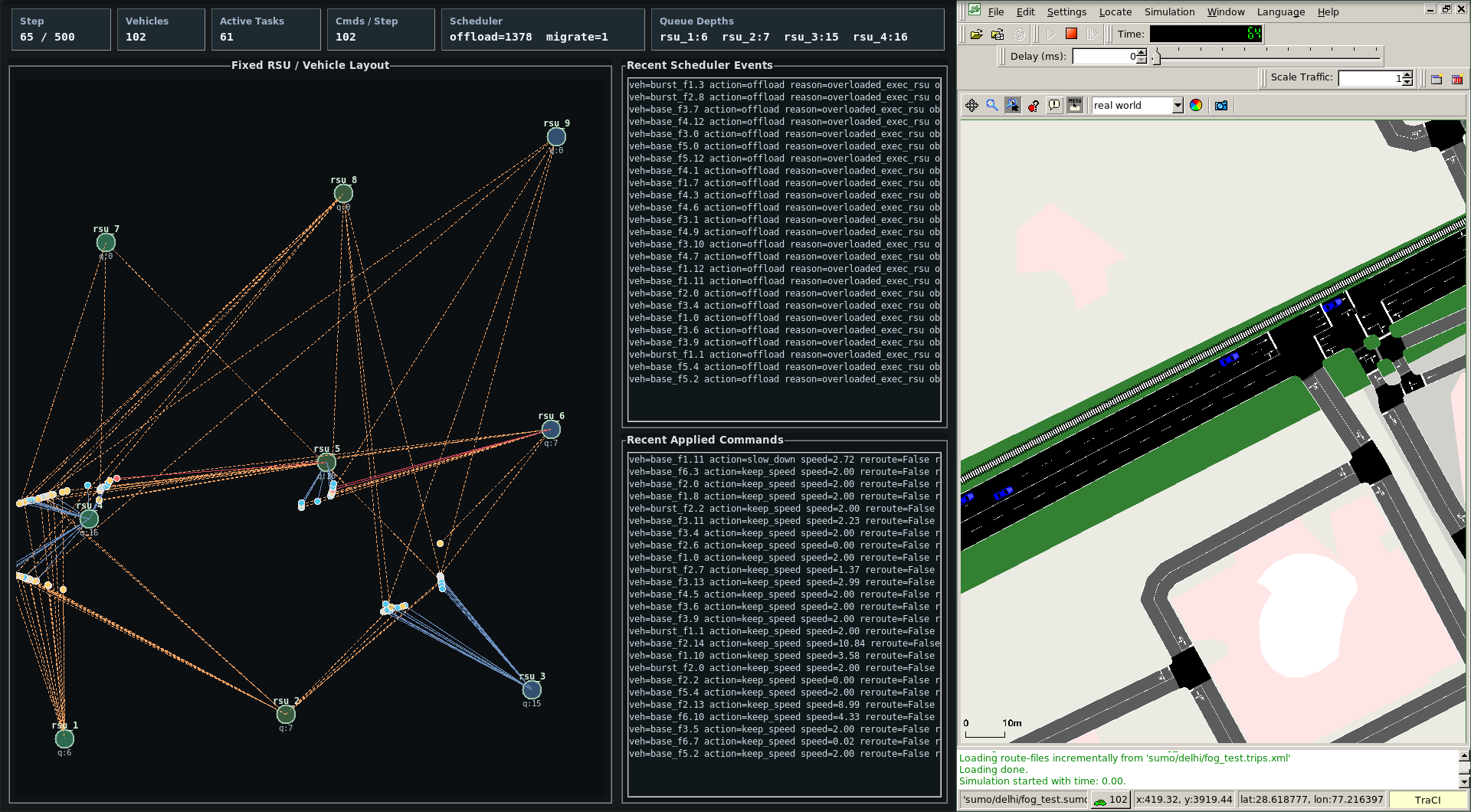
CoFog-SUMO links SUMO's microscopic traffic simulation with YAFS's discrete-event SimPy engine over a step-locked TraCI bridge, translating computational load into physical speed moderation and route diversions.
Synchronized Closed-Loop Co-Simulation
Real-time multi-panel dashboard displaying live vehicle positions, RSU queue depths, and TraCI actuation signals
Synchronized Closed-Loop Co-Simulation
Real-time multi-panel dashboard displaying live vehicle positions, RSU queue depths, and TraCI actuation signals
Step-Lock TraCI Bridge
Advances microscopic Krauss car-following time-steps in sync with discrete-event packet scheduling without clock drift.
Lateral Mesh Fog Topology
Executes arbitrary NetworkX graph topologies with lateral RSU-to-RSU links rather than rigid tree hierarchies.
Adaptive Deadline & Actuation Governor
Weighs task workload and queue depths to trigger offloading, with a 5.0s actuation cooldown window preventing phantom traffic waves.
03 // THE HARD PROBLEM
Coupling Continuous Kinematics to Discrete Events Without Traffic Shockwaves
Synchronizing SimPy event queues with TraCI time-steps while eliminating phantom traffic jams
SUMO advances on fixed delta-time intervals (0.5s or 1.0s), whereas YAFS advances on irregular discrete event occurrences. Naive per-packet socket queries created tens of thousands of round-trips per step, ballooning runtimes from minutes to hours. Simultaneously, when the edge layer commanded vehicles to slow down to maintain V2I dwell time, abrupt deceleration propagated through following vehicles in the Krauss model, producing severe phantom traffic shockwaves along the corridor.
- ✕Individual per-packet TraCI polling caused severe socket serialization bottlenecks and blocked the SimPy event loop
- ✕Unconstrained deceleration feedback triggered chain-reaction braking waves that gridlocked dense multi-lane intersections
Centralized state ingestion in MinimalFogSim.process_step, batching vehicle coordinates into an in-memory registry per TraCI tick before stepping the SimPy timeline. Added an individual vehicle cooldown window (T_cooldown = 5.0s) and hierarchical speed governor to absorb actuation transients and protect traffic flow stability.
04 // SYSTEM BLUEPRINT
Bidirectional Bridge & Closed-Loop Actuation Pipeline
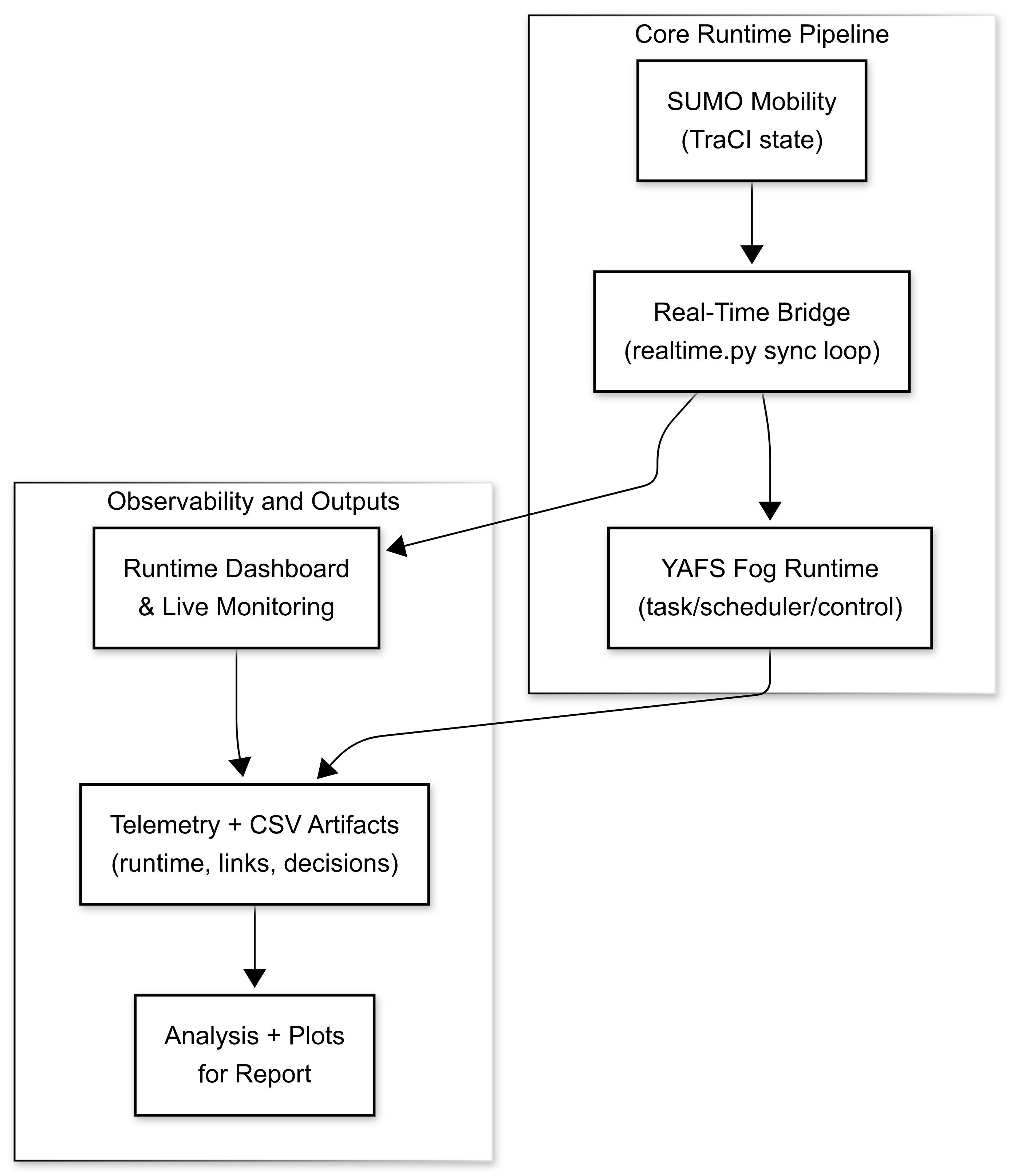
Step-locked execution loop separating physical mobility ingestion from graph-based fog processing and feedback actuation.
Execution Flow Sequence
SUMO Mobility Core
Mobility EngineMicroscopic car-following dynamics, signalized junctions, and vehicle kinematics along the Delhi corridor
Step-Locked TraCI Bridge
TCP SocketSocket interface synchronizing SUMO steps with YAFS discrete-event compute execution
Adaptive Scheduler & Fog Engine
Decision CoreSimPy/NetworkX mesh graph evaluating EWMA backhaul latency and queue backpressure
05 // ARCHITECTURAL TRADEOFFS
Decisions & Cyber-Physical Compromises
Key design choices balancing co-simulation throughput, mathematical fidelity, and physical traffic stability.
Rationale: Vehicular kinematic positions change negligibly within 500ms, while sub-millisecond TraCI socket polling created massive IPC overhead that caused simulator stalls.
Resulting Impact: Achieved 18.4ms per-step wall-clock latency, allowing co-simulation execution 27x to 54x faster than real time.
Rationale: Migrating active task state across backhaul links introduces state transfer latency. If the origin RSU can complete computation within the remaining deadline slack, keeping the task avoids network congestion.
Resulting Impact: Eliminated unnecessary state transfers and prevented ping-pong migration loops along cell edges.
Rationale: Immediate consecutive speed reductions cause trailing vehicles in the Krauss car-following model to brake abruptly, inducing artificial traffic jams.
Resulting Impact: Maintained corridor traffic flow stability while achieving a 34% reduction in deadline misses.
06 // BENCHMARKS
Empirical Delhi Corridor Outcomes
Profiled across a 9-RSU arterial corridor over 500 simulation steps under varying vehicular traffic densities.
Sync Overhead
18.4ms
±3.2ms per step execution
Fairness Index
J = 0.84
Jain's index vs greedy baseline
Deadline Miss Cut
34%
via kinematic dwell time extension
Step execution latency (ms)
Continuous Benchmarking
* All metrics benchmarked on the Delhi arterial OSM corridor using 9 RSUs with capacity C_r = 20 tasks/unit.
07 // PROOF & ARTIFACTS
Verified Code, Scenarios & Conference Research
Open-source co-simulation harness, OpenStreetMap network scenarios, and IEEE conference paper repository.
GitHub Repository (Confidential / Private)